
Have you noticed cracks in your foundation walls, uneven floors, sticking windows or other signs of foundation problems? You may need foundation settlement repair.
At LRE Foundation Repair, we fix foundation settlement issues by installing steel foundation piers.
These piers extend beneath your foundation, contacting strong supporting soils that will permanently stabilize your structure. As specialists in foundation repair, we can ensure there’s a solution to your sinking settlement with us.

Identifying Foundation Settlement Issues
There are usually a number of different soil layers underneath a property. Foundation settlement and house movement can occur when one of these soil layers can't support the weight.
Signs of a settling foundation can be very subtle at first. Many homeowners can go months or even years before noticing a crack in their foundation. The long-term damage from foundation settlement, however, is ongoing and will lead to more severe foundation problems.
When inspecting properties, there are 5 typical signs of foundation settlement:

Stair-Step Cracking
Stair-step cracking is very common in brick and concrete block walls and is a sure sign of foundation settlement. As the settlement house movement continues, vertical cracks may widen or become uneven as wall sections tilt away from each other, indicating more severe displacement. Keep an eye out for cracks that are wider at the top than at the bottom, as this is a sign of advancing settlement.
Tilting Chimneys
Tilting chimneys that are separating from the home are one of the most intimidating and dramatic signs of a settling foundation. Sometimes a chimney is built on a footing that is not connected to the house foundation. In this situation, the enormous weight of a chimney can make it even more at risk of settlement.
Damaged Doors & Windows
An opening cut in any wall is a weak point, so signs of foundation settlement and house movement often show up around door and window openings. Doors and window frames may be racked out of square, cracks may extend from the corners above doors and windows, and doors may separate from the framing or exterior finish. Other signs of foundation settlement include sticking or jamming doors and windows, and locks that stop working.
Slab Floor Cracking
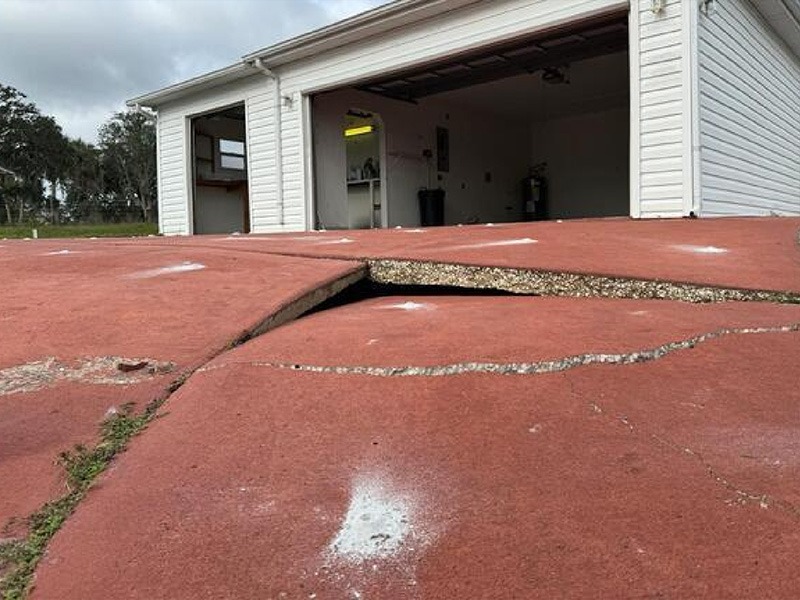
Cracks in your concrete floor slab can be a sign of foundation settlement, but they may also be a sign that the slab floor alone has settled. There are times when your slab floor may sink or lift independently of the foundation walls, damaging the floors but not necessarily the foundation walls themselves.
Drywall Cracks
Cracks in drywall throughout the house are reliable indicators of foundation settlement. Cracks will often be larger and more obvious in the home’s upper levels. Typical drywall cracks during foundation settlement are commonly located at the corners of doors and windows and along drywall seams. Drywall tape can also be a good indicator, especially if it’s ripping or coming loose. Drywall cracks can also be a sign of sinking crawl space supports, sinking floors, and heaving floors.
Foundation Helical Piers
Like push piers, helical piers are attached to the foundation by mounting a bracket. Helical piers include rotating blades that are advanced (or screwed) into the soil.
Foundation helical piers are straight, steel piers that have helical blades welded to each shaft. This installation is possible from either inside or outside of your foundation.
These piers are driven into the soils underneath your foundation, then each pier is connected to the structure’s foundation via a steel bracket.

Helical pier installation
During the installation, a section of the footing is exposed and cut for each bracket. Next, round-shaft helical piers are mechanically advanced into the soil.
Once the helical pier has been advanced into the soil, a foundation bracket is secured to the footing. When all helical piers have been installed, they will work in unison to transfer the weight of the structure to competent soil. If possible, the structure is also lifted back to a level position.

Slab Pier Systems
When the soil beneath a concrete slab shrinks or settles, the slab itself is also likely to settle, often cracking in the process. Slab piers restore stability by connecting the slab to competent soil at greater depth.
Foundation slab piers are straight steel piers that extend from stable soils deep below the structure to support brackets directly in contact with the underside of the slab. These piers are meant to support a settling concrete floor, and are not appropriate for foundation wall stabilization.
Slab piers are also inappropriate for repairing heaving foundations, where the floor is being lifted by expansive soils or frost heave.
Slab pier installation
During installation, a small hole is cored through the concrete floor. A slab bracket is assembled beneath the concrete slab, and steel tubes are hydraulically driven down through this bracket assembly.
When the slab piers have reached competent soils, the weight of the slab is transferred through the piers to load-bearing soils below. If possible, the slab is lifted back to level position.
At the end of the installation, grout is pumped under the slab to fill any voids, and all cored holes in the slab are restored with new concrete for a clean, professional look.
Foundation repairs we never perform
Like all home improvements and repairs, some foundation repair methods work better than others. Based on our experiences throughout Florida, here are three foundation fixes that we do NOT recommend:
Call foundation settlement repair experts in Florida!
At LRE Foundation Repair, we can identify and repair any issue you may be having with settling, sinking foundations, and settlement house movement.
We have a wide variety of solutions for foundation repair that have been tested and proven effective throughout the United States and Canada through the Supportworks network of foundation contractors.
Each of our solutions starts with a free, written foundation repair inspection, and includes a personal consultation with a foundation expert for an in-person inspection.
To schedule an appointment with one of our specialists, give us a call at 1-844-610-2840 or email us today! We proudly serve Tampa, Orlando, Saint Petersburg, Bradenton, Lakeland, Sarasota, Ocala, Kissimmee, Daytona Beach, Clearwater, and nearby.
What To Expect
Ready to get started?
Schedule a free estimate to start your repair journey with LRE.

Schedule your inspection
Fill out our form or give us a call to book your inspection. Share what you’ve noticed so we can send the right expert to your home.

Full home
inspection
An expert will inspect the problem area and surrounding conditions, including soil movement, drainage, structural integrity, and any related concerns.

Clear explanation
of findings
We’ll walk you through what we’re seeing in easy-to-understand language so you know the root cause of the issue, not just the symptoms.

Review recommendations
If repairs are needed, we’ll outline your options, pricing, and timeline so you can make the best decision for your home.
Schedule your free inspection—
It'll only take
a minute
Meet with a trusted expert, and get
clear answers about your home.